How to Talk to Your Child about Limb Difference Overuse Syndrome
Supporting body care without fear, pressure, or singling out
A helpful way to think about this: brushing teeth
Why body care works best as a routine
Starting the conversation at different ages
Make it a whole-family practice
Language matters
Supporting lifelong habits
Free resource
Learn more
Before we talk about how to reduce overuse syndrome risk, it helps to talk about how to talk about it with your child.
Children with upper limb differences don’t need complicated explanations or heavy conversations about future pain. What they benefit from most is age-appropriate language that frames body care as a normal part of everyday life — something the whole family does together.
A helpful way to think about this: brushing teeth
Many parents find it useful to think about overuse prevention the same way we think about dental care.
We do not wait for cavities to teach children to brush their teeth, and we do not scare them with worst-case outcomes. We explain, matter-of-factly, that teeth need regular care to stay healthy. When children are young, we brush with them or for them. Over time, they take on more responsibility as they are ready.
Overuse prevention works the same way.
Instead of teaching children to be afraid of their bodies, we help them build simple habits that protect their bodies over time.
Why body care works best as a routine
Parents often ask whether they should check in with their child by asking if they are in pain or if they want to take a break. While this may feel respectful, it is often not the most effective approach for young children.
There are several reasons for this:
- young children may not have the body awareness to notice early fatigue or strain
- they may not want to interrupt an activity they are enjoying
- they may say that they are not in pain to avoid worrying the adults around them
Because of this, body care works best when it is built into the routine rather than treated as a decision children must make in the moment. This is why adults play an important role in guiding and modeling these habits early on.
As children grow into adolescence, this guidance naturally shifts toward collaboration and independence.
Starting the conversation at different ages
Body care conversations do not need to be formal or scripted. Small, repeated messages are often the most effective.
For younger children, language can be simple and playful:
- “Let’s help both arms/sides get strong.”
For school-age children:
- “Your body did a lot today. A short break helps it stay strong.”
- “Let’s stretch because your muscles worked hard”
- “Stretching helps your muscles recover.”
For tweens and teens:
- “Let’s do planks together to strengthen our shoulders!”
- “Breaks help you keep doing what you love.”
Make it a whole-family practice
When body care habits are something the entire family participates in, children with limb differences are less likely to feel singled out.
Stretching together, taking movement breaks, and talking out loud about rest and recovery helps normalize body care for everyone. It sends the message that caring for our bodies is something all people do, not something only one child needs.
Language matters
The words adults use shape how children think about their bodies.
While you are having conversations with your child about overuse syndrome, it’s best to choose neutral, descriptive language such as “limb different side,” “shorter arm,” or “helping arm” to support confidence and reduce comparison. Avoiding terms like “bad,” “weak,” or “normal” can help children develop a sense of acceptance, rather than judgment, about their body.
Supporting lifelong habits
These conversations are not about limiting activity or watching for problems. They are about planting seeds.
Children who grow up with routine body care habits are better prepared to notice fatigue, respect their bodies, and advocate for themselves later in life. This matters because many adults with limb differences report experiencing overuse pain, often without having had the language or framework to understand what was happening.
Early awareness and supportive routines can make a meaningful difference over time.
Free resource
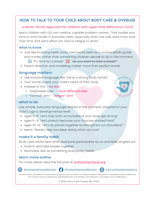
To support these conversations at home, you can download a one-page handout that summarizes:
- why routine matters
- age-appropriate language examples
- how to make body care a whole-family practice
👇 Download the free handout: “How to Talk to Your Child About Body Care & Overuse”
Learn More
If you would like to continue learning about overuse prevention, strength, and sustainable movement for children with upper limb differences, follow on Instagram and subscribe to our newsletter.
👉 To access more overuse syndrome information, visit the overuse syndrome hub.
© 2026. Laura Faye Clubok, MS, OTR/L, On The Other Hand Therapy