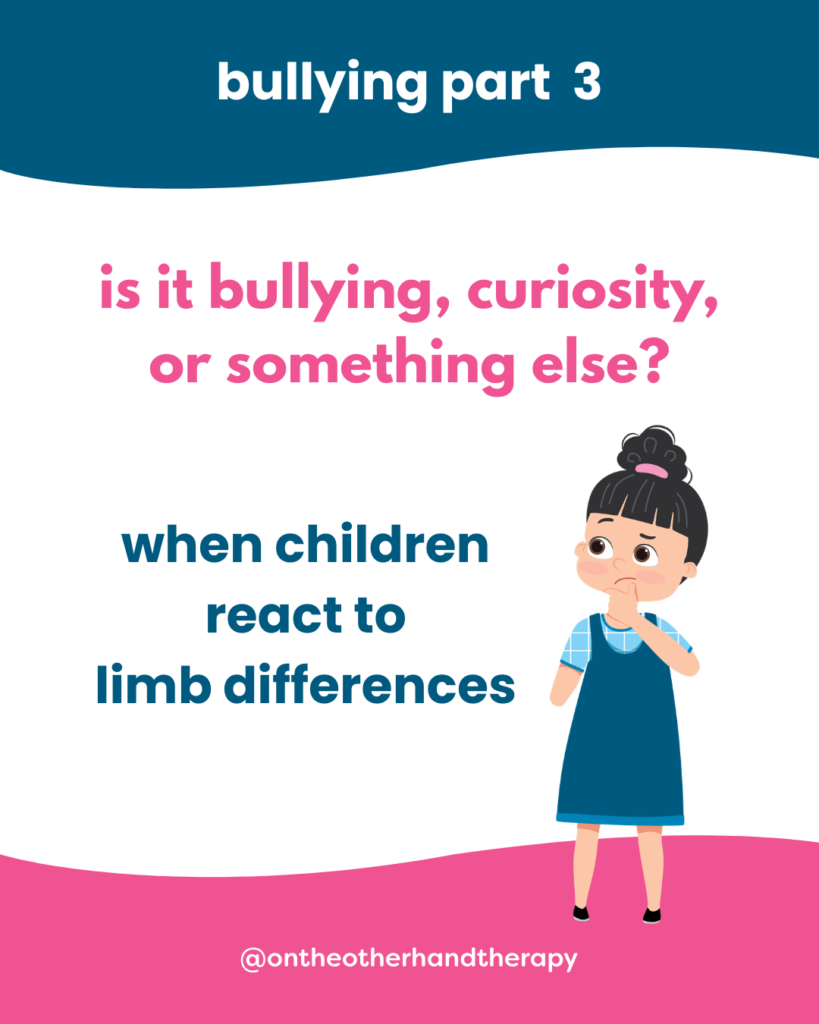
Bullying Part 3: Is It Bullying, Curiosity, or Something Else?
When children react to limb differences
This post is the third of a three-part reflection on bullying; be sure to read:
👉 Bullying Part 1: Understanding Exclusion and Social Systems (and grab the free handout!) and
👉 Bullying Part 2: Practical Guidance for Parents
Difficult moments
A situation many families experience
Three common ways children react to differences
Why the gray areas matter
The touching issue: a common experience
What parents can do when something happens
Helping children build confidence
A final thought
About professional support
Learn more about bullying
Difficult moments
Children with visible differences sometimes face difficult moments at school or on the playground.
A child may stare.
Or ask a blunt question.
Sometimes a child may even reach out and touch a hand or arm that looks different.
And occasionally, a child may say something deeply hurtful.
When this happens, parents often find themselves asking an important question:
Is this bullying?
Sometimes the answer is yes. But often the situation is more complicated.
Understanding the difference can help parents respond thoughtfully, advocate effectively, and support their child’s confidence.
A situation many families experience
Recently, I came across a discussion among parents of children with limb differences about an incident that occurred in an early elementary setting.
Details have been generalized to protect privacy, but the situation reflects a common experience many families face.
A child grabbed another child’s hand and tried to pull their fingers apart, making a comment about how their hand “should look normal.”
The parent who shared the story was understandably upset and asked for advice about how to respond with the school.
The responses ranged widely:
- Some people said the parent should report it as assault.
- Others said this kind of thing is simply part of life for children with visible differences.
- Many parents recommended talking to the teacher and school administrators.
- Several former educators explained that teachers cannot always watch out for these behaviors.
All of these reactions reflect very real emotions, but the truth usually lies somewhere in the middle.
Situations like this often fall into what are gray areas of childhood social behavior.
Three common ways children react to differences
Most peer interactions around visible differences fall into one of three categories. Understanding these can help parents interpret what happened and decide how to respond.
1. Curiosity without awareness
Young children are naturally curious about bodies and differences. They may:
- stare
- ask blunt questions
- try to touch a hand or arm that looks different
Children affected by these behaviors and parents who later find out about an incident can experience a range of reactions: shock, discomfort, anger, frustration, confusion.
In many cases, the child simply does not yet understand social boundaries. This doesn’t mean the behavior should be ignored. Children still need to learn that people’s bodies deserve respect and personal space.
However, it is important to consider the age and developmental level of the child who engaged in the offending behavior; curiosity and cruelty are not the same thing. Most often the best response for young children is gentle guidance and explanations from adults.
2. Social experimentation
As children grow, they begin to explore social dynamics and power within peer groups.
Sometimes children can ask questions or make comments that can sound harsh, such as:
- “Why is your hand weird?”
- “You should be normal like everyone else.”
- “Your hand is scary”
Comments like this can evoke deep pain for a child who hears them. But developmentally, these statements often reflect a child who is testing reactions, repeating language they’ve heard, or trying to fit in socially, rather than intentionally trying to harm another child.
This doesn’t make the behavior acceptable, but it does mean the response likely should focus more on teaching and coaching than punishment.
3. Bullying
Bullying typically involves behavior that is:
- repeated
- intentional
- meant to humiliate, isolate, or hurt someone
Examples might include:
- repeatedly teasing a child about their difference
- encouraging others not to play with them
- mocking their appearance
- targeting them over time
When patterns like this emerge, stronger intervention from adults and schools is necessary.
👉 To learn more about bullying, read Bullying Part 1: Understanding Exclusion and Social Systems.
Why the gray areas matter
Not every difficult interaction between children is bullying, but that doesn’t mean parents should ignore situations where a child is singled out, treated unfairly, or “othered.”
Many experiences fall somewhere in the middle: moments where a child crossed a boundary or said something hurtful but may not yet understand the impact of their actions.
In these cases, the goal is often education, boundaries, and awareness, not simply punishment.
The touching issue: a common experience
Children with limb differences often experience something many adults never think about. Other children may try to:
- examine the difference up close
- grab their hand/arm
- pull on a prosthetic
- spread their fingers
This can feel invasive and upsetting. One of the most helpful skills children can learn is simple boundary language, such as:
- “Don’t touch my arm.”
- “I don’t like that.”
- “Stop!”
Learning to set boundaries is empowering and gives children a way to protect their own personal space.
What parents can do when something happens
If your child comes home with a story like this, it’s normal to feel protective or upset.
A helpful approach often includes a few steps.
1. Listen carefully.
Let your child describe what happened in their own words. Even if you are tempted to ask questions , it’s important to avoid interrupting.
2. Validate feelings.
If your child felt embarrassed, confused, or hurt, those feelings matter and it can be helpful to name the feelings. This step may take some time; try not to rush it by moving to step 4.
3. Gather information.
Was this a one-time incident, or has something similar happened before?
4. Decide whether to communicate with the school.
Most educators want to create respectful environments for all students. When in doubt, especially if the child is young, inform the teacher.
Teachers and staff can’t see every interaction. This is especially true during busy times such as lunch, recess, and transitions. Teachers can help guide children’s behavior once they know what occurred.
If you choose to communicate with your child’s teacher or a school administrator, it’s important to present facts calmly and with respect. Most teachers are on your side, so let them do their job!
5. Moving forward, identify a “safe person” at school.
It can also be helpful for your child to identify a “safe person” at school — someone they know they can go to if something uncomfortable happens. This might be a teacher, aide, older sibling, or another trusted adult. Knowing exactly who to go to can help children feel more secure and supported in a difficult moment.
Helping children build confidence
Parents often wish they could protect their child from every uncomfortable interaction.
Unfortunately, that’s not realistic. What parents can do is help children build the confidence and skills to navigate these moments when they arise.
That might include:
- practicing responses to questions
- learning how to set boundaries
- connecting with other children who have limb differences
- reinforcing that different bodies are a natural part of the human experience
These tools help children feel prepared rather than powerless.
A final thought
Children are still learning how to understand differences, respect boundaries, and navigate social relationships.
Sometimes they get it wrong. When difficult moments happen, parents and educators have an opportunity to help all children grow in empathy, understanding, and respect.
And with guidance, those lessons can make schools safer and more inclusive places for everyone.
When children know who they can go to and what they can say, they are more likely to feel prepared rather than powerless when difficult moments arise.
About professional support
This information is intended for general education. It is not a substitute for individualized support from a licensed healthcare, mental health, or educational professional. If you have concerns about your child’s emotional well-being, functioning at school, or safety, seeking individualized support is an important next step.
Learn more about bullying
If this topic resonates with you or if your child is experiencing peer challenges, you may also find these helpful:
👉 Bullying Part 1: Understanding Exclusion and Social Systems — grab the free handout!
👉 Bullying Part 2: Practical Guidance for Parents
These reflections on bullying look beyond surface-level advice and explore emotional and relational layers for children with limb differences.
© 2026. Laura Faye Clubok, MS, OTR/L, On The Other Hand Therapy. All rights reserved.