
Bullying Part 1: Understanding Exclusion and Social Systems
A developmental and occupational therapy perspective
This post is the first of a three-part reflection on bullying; be sure to read
👉 Bullying Part 2: Practical Guidance for Parents and
👉 Bullying Part 3: Is It Bullying, Curiosity, or Something Else?
Introduction
Bullying can take many forms
What does and does not count as bullying
When bullying isn’t obvious: relational aggression
Cyberbullying and digital spaces
Why children with visible differences are often targeted
Bullying is not just an individual coping issue
Why self-advocacy alone is not enough
Why adults often miss what is happening
Friendship fit matters
A note to parents
Free resource
Learn more
Introduction
Bullying does not always look the way we expect it to.
For children with visible differences, including upper limb differences, social harm often exists on a spectrum, from overt teasing or name-calling to subtle exclusion, joking, or story-making that is framed as “funny” or “no big deal.”
Bullying can take many forms
When parents think of bullying, they often imagine name-calling or physical conflict. But bullying can also be subtle and understated.
Bullying and social harm can:
- Be obvious or very subtle
- Come from strangers or close friends
- Happen multiple times in close succession or unfold slowly over time
For many children, the most painful experiences are not with strangers, but with friends who begin to treat them differently. This may happen when:
- A peer wants to fit into a new social group
- A child tests social power by aligning with peers who bully others
- Differences between children become more noticeable with age
Teasing or exclusion that comes from someone a child trusted can feel confusing and deeply hurtful, especially when dismissed as “joking.” Some of the most painful experiences children face happen through subtle social exclusion or friendship manipulation, patterns especially common among girls.
What does and does not count as bullying
Bullying is typically defined as a repeated pattern of behavior that is intended to harm, exclude, intimidate, or humiliate, and that involves a real or perceived power imbalance.
This may include:
- Repeated teasing or mocking
- Ongoing exclusion
- Name-calling or threats
- Targeting a visible difference
Not all unkind behavior meets this definition. A single hurtful comment, a misunderstanding, or a conflict between friends, while still painful, is not necessarily bullying.
That said, one-time incidents still deserve attention, especially when they involve a child’s body, disability, or identity. What matters most is watching for patterns over time and how the experience is affecting the child.
When bullying isn’t obvious: relational aggression
It can be hard for adults to recognize some forms of bullying.
Among girls in particular, bullying often takes the form of relational aggression. Instead of direct insults or physical conflict, it may involve social manipulation designed to damage a child’s relationships or sense of belonging.
This can look like:
- Excluding someone from a friend group
- Whispering or talking about someone behind their back
- Spreading rumors
- Rolling eyes or exchanging looks meant to humiliate
- Telling others not to play with a particular child
- Being friendly one moment and suddenly cold the next
Because these behaviors are subtle, adults may miss them entirely. A teacher might see a group of girls quietly working together and assume everything is fine, while one child feels deeply isolated within that group.
For children with visible differences, such as a hand or arm difference, these dynamics can become particularly painful. The bullying may not focus directly on the difference. Instead, the child may be pushed to the edges of social groups, left out of games, or treated as “different” in ways that are difficult to name.
Parents sometimes hear things like:
- “They said I couldn’t sit with them today.”
- “They’re having a party but I’m not invited.”
- “They were whispering about me.”
These experiences can be just as damaging as more obvious bullying, even though they are harder to document or intervene in.
Understanding relational aggression can help parents recognize that bullying is not always loud or visible. Sometimes it happens quietly, in the subtle social dynamics of childhood friendships.
Parents who want to understand these dynamics in more depth may find the book Queen Bees and Wannabes by Rosalind Wiseman helpful. It explores how social hierarchies and exclusion can develop among girls during the school years.
Cyberbullying and digital spaces
For many children and teens, bullying does not stop at the school door. Cyberbullying can include:
- Hurtful messages or comments
- Group chats used to exclude or mock
- Sharing images, videos, or private information
- Ongoing harassment through social media or gaming platforms
Because cyberbullying often happens privately, children may hesitate to tell adults, especially if they fear losing access to devices or social connection. Parents can support by:
- Keeping communication open about online spaces without immediate punishment
- Treating online harm with the same seriousness as in-person harm
- Documenting patterns (screenshots, dates) if intervention becomes necessary
- Involving school staff when online behavior intersects with school relationships
As with in-person bullying, greater focus should be on patterns and impact than on isolated moments. 👉 Visit Part 2: Practical Guidance for Parents for cyberbullying resources.
Why children with visible differences are often targeted
Noticing differences is a typical part of children’s development. Problems arise when curiosity is not guided by adults and turns into repeated comments, teasing, or exclusion.
Importantly, the issue is how differences are handled within the social environment, not the child’s body.
When children are not supported in learning how to engage respectfully with difference, harm can occur even without malicious intent.
Bullying is not just an individual coping issue
Bullying is often framed as something a child should learn to handle on their own. This framing misses a critical truth:
Bullying is not just an individual coping issue. It is a systems issue that requires different responses depending on the child’s age, capacity, and environment.
Expecting a child to self-advocate in an environment that does not support them places too much responsibility on the child and too little on the system around them.
Why self-advocacy alone is not enough
Self-advocacy is a skill that develops over time. Younger children, in particular:
- May speak up and still be ignored
- May be mocked for asserting boundaries
- May lack the social power to change peer behavior
This does not mean self-advocacy is unimportant. It means adult support remains essential, especially in childhood.
Why adults often miss what is happening
Bullying and exclusion often:
- Happen when adults are not present
- Are hidden behind humor or charm
- Appear inconsistent or hard to “prove”
Children who engage in bullying may behave very differently around adults, which can make children who are targeted feel doubted or unsupported.
Friendship fit matters
Learning to notice how someone treats you and how you feel in their presence are lifelong skills.
Not every peer or peer group will be a good fit, and recognizing that a relationship is no longer supportive does not represent social failure. It reflects growing social-emotional awareness and self-respect.
Children benefit when adults reinforce that:
- Being included should not require tolerating repeated unkindness
- Friendship quality matters more than social status or convenience
- Moving toward healthier relationships is a strength, not a loss
This framing helps children understand that social change is part of development, not a reflection of their worth.
A note to parents
Many parents reading this may recognize situations that have already happened or patterns they wish they had understood earlier. These dynamics are rarely explained to families in advance, and most parents are doing the best they can with the information they have at the time. Wherever you are in your journey, it is never too late to reflect, adjust, and support your child in ways that foster safety, confidence, and belonging.
Free resource
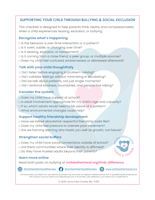
👉 Download the free handout, Supporting Your Child Through Bullying & Social Exclusion
Learn more
👉 In Bullying Part 2: Practical Guidance for Parents we explore what parents can actually do: how to talk with their child, when to step in, and how to support social and emotional well-being over time.
👉 In Bullying Part 3: Is It Bullying, Curiosity, or Something Else? we cover how it can be hard to know what’s happening when a child stares, asks questions, says something hurtful, or touches your child’s limb difference. We’ll try to tease out the difference between curiosity, social behavior, and true bullying, so you can support your child with clarity and confidence.
© 2026. Laura Faye Clubok, MS, OTR/L, On The Other Hand Therapy. All rights reserved.